Showing posts with label electricity. Show all posts

Thursday, April 22, 2010

On electricity tariffs and fossil fuel subsidies

With the rising costs of fossil fuels and fossil-fuel based electricity generation, disparities in electricity tariffs and persistently high fossil-fuel subsidies are coming under the spotlight. This has important implications for South Africa's possible economic development trajectories.

From Moneyweb (see also Politicsweb with a link to the leaked dossier):

The Democratic Alliance (DA) can this morning reveal a secret 291 page Eskom dossier, which provides definitive proof, amongst other things, that Eskom has been charging vastly discounted electricity tariff rates to companies that provide little or no benefit to the South African economy. The document was leaked from high level officials in Eskom to the DA and we made use of its information yesterday to question the acting CEO in the portfolio committee on public enterprises. The chairperson of the portfolio committee tried to tell us not to use the report, but we are today releasing it in full, because we believe its contents are of manifest importance to the South African public. This report stands alongside the now notorious Olsen Report - also released publicly by the DA - in that it provides cast iron evidence of the extent of mismanagement at Eskom, the ANC government's complicity in it, and the damage that is being done to the South African economy as a consequence.

The signs were there much earlier as reported in the press (see here for example) and also on this blog in the context of potential additional carbon costs:

At an average emission rate of close to 0.9kg CO2/Kwh and a price for carbon between $20 and $40 per tCO2 start penciling in an additional cost of between 14-28 cents per Kwh ($1 = R7.5). To place this in perspective Business Day reports: Eskom is understood to have guaranteed the Coega project electricity at 14c/kWh.

Who pays the rest?

What was meant as a rhetorical question way back then is coming clearly in focus now. Of course, we South African citizens have been paying the rest, directly through our electricity bills and indirectly, with other global inhabitants, through the impacts of a changing climate.

Also this morning in my inbox was a study on worldwide fossil fuel subsidies - amounting to a whopping $500 billion annually. According to the report, South Africa subsidised electricity costs at almost $10 billion annually. It was not clear from the report what exactly went into this $10 billion, but that this is substantial is without doubt.

Cheap electricity used to be an integral part of South Africa's industrial policy. With rising electricity prices and potential carbon liabilities the costs of such a policy is becoming rapidly clearer. What the implications are and whether this creates space for new opportunities has been the focus of debate for some time now.

In this time of transition towards a new electricity regime expect more painful stories and hope for wise leadership in seeing opportunities.

Friday, November 13, 2009

Africa's Infrastructure Challenge


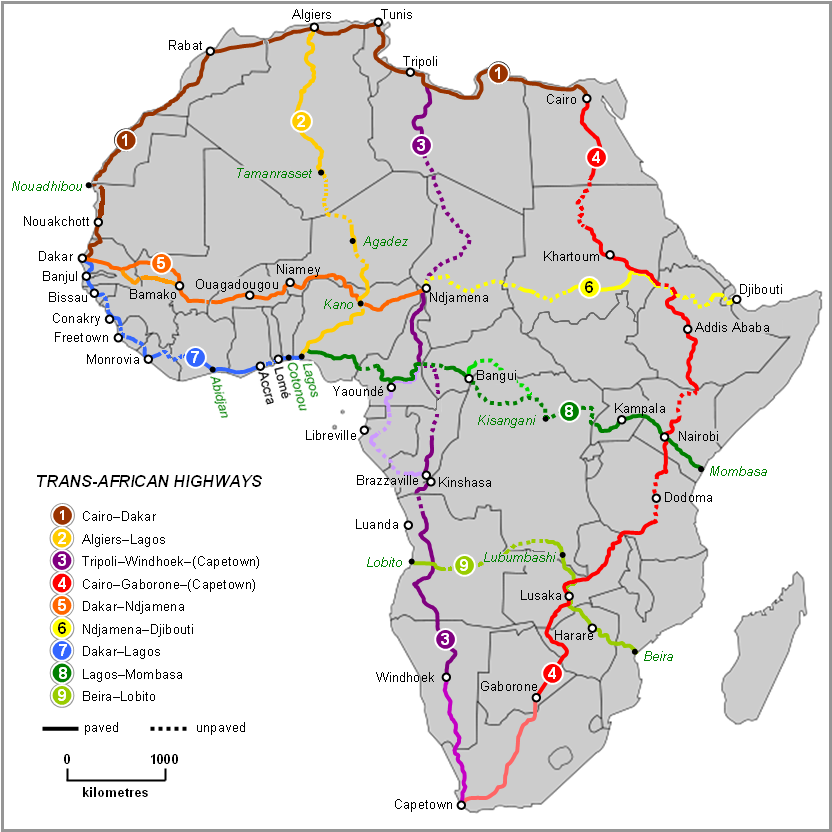
The IBRD and World Bank released a report entitled "Africa's Infrastructure: A Time for Transformation", estimating that the cost of addressing Africa's infrastructure challenge is $93bn per year, one third of which is for maintenance alone.

Other main findings are that infrastructure has been responsible for more than half of Africa's recent improved growth performance, that infrastructure networks are lagging behind other developing countries, that infrastructure services in Africa are twice as expensive as elsewhere, and that infrastructure in Africa is mainly financed by central governments.

For more findings and well-researched discussions read the full report here.

H/T: Polity
Image: WikiMedia

Tuesday, November 10, 2009

On access to electricity and higher education in SA

A beautiful graph from GapMinder showing the relationship between access to electricity and higher education for South African municipalities.

A few observations:
- Access to electricity increases markedly over this time period
- The percentage of with higher education increases up to 2000, and started decreasing since then, but with some notable exceptions
- The curve is pulled back towards the left-hand corner as time progresses; improved access to electricity without corresponding gains in higher education.
- A notable rebound effect from 2001 onwards - access to electricity still improved in most cases, but percentage of population with higher education starts to fall behind

This signals pressure on higher education, especially from 2001 onwards, that is not directly related to the lack of access to electricity. This failure is not uniform throughout the country though.

Wednesday, October 14, 2009

Rising prices and... rising demand!?

Again...

Will electricity demand keep on increasing while prices are rising? (A few days ago I posted on a study done by the University of Pretoria showing a substantial reduction in electricity demanded when prices double)

Eskom seems to think that they can have both raising prices and raising demand as evident from their Proposed Revenue Application. Quoted from the document (p 30, for simplicity I am only showing the low sales scenario here):

The sales forecast for the next 10 years has some downside risk (i.e., lower sales) based on the

depth and length of the economic slowdown especially for the first 2 years.


Low

(GWh) % Growth

2010/11 220,260 1.0%

2011/12 224,737 2.0%

2012/13 232,388 3.4%

2013/14 239,536 3.1%

2014/15 248,621 3.8%

2015/16 258,921 4.1%

2016/17 265,399 2.5%

2017/18 271,946 2.5%

2018/19 279,163 2.7%

2019/20 286,388 2.6%


Economic theory says that as electricity prices rise the quantity of electricity demanded will fall, holding other factors constant. The percentage change in quantity demanded in relation to the the percentage change in price is called the price elasticity of demand.

Electricity demand traditionally was relatively inelastic to price which basically means that the rate at which demand slowed down was much less then the rate at what prices increased. There are many different price elasticities for different regions and sectors, but it seems that most tend to converge around a range of -0.2 to -0.7. That means that a 1% increase in price would lead to between 0.2 to 0.7% reduction in demand. There are also signs, at least in the US economy, that price elasticity of electricity is increasing.

This raises questions on the assumptions used in the utility's modelling as well as more serious implications of this modelling and the practical need to entrench market power from the utility's perspective. Will customers be freely allowed to respond to raising electricity prices even if it reduces the demand and thus the sales of the utility? Looking at Eskom's modelling assumptions I am not convinced.

(But then, we need to be sure that all substitutes for Eskom electricity are factored in (what substitutes?), and that the powering forces of raising incomes in South Africa will dwarf the increases in price (really?)).

See, I am still not convinced.

Thursday, October 8, 2009

Will rising electricity prices reduce demand?


Analyse both price and quantity effects! Therefore it is quite a relief to see a new research paper attempting to quantify the effects of rising electricity prices on demand.

In the new paper " Aggregate electricity demand in South Africa: Conditional forecasts to 2030", Roula Inglesi at the University of Pretoria argues that electricity demand will drop substantially due to the price policies agreed – until now – by Eskom and the National Energy Regulator South Africa.

This is the full abstract of the paper:

In 2008, South Africa experienced a severe electricity crisis. Domestic and industrial electricity users had to suffer from black outs all over the country. It is argued that partially the reason was the lack of research on energy, locally. However, Eskom argues that the lack of capacity can only be solved by building new power plants.The objective of this study is to specify the variables that explain the electricity demand in South Africa and to forecast electricity demand by creating a model using the Engle–Granger methodology for co-integration and Error Correction models. By producing reliable results, this study will make a significant contribution that will improve the status quo of energy research in South Africa.

The findings indicate that there is a long run relationship between electricity consumption and price as well as economic growth/income. The last few years in South Africa, price elasticity was rarely taken into account because of the low and decreasing prices in the past. The short-run dynamics of the system are affected by population growth, too. After the energy crisis, Eskom, the national electricity supplier, is in search for substantial funding in order to build new power plants that will help with the envisaged lack of capacity that the company experienced. By using two scenarios for the future of growth, this study shows that the electricity demand will drop substantially due to the price policies agreed – until now – by Eskom and the National Energy Regulator South Africa (NERSA) that will affect the demand for some years.

In a summarised discussion in the monthly AfriNem Newsletter the following telling graph on projected electricity demand (assuming a doubling of the price of electricity from 2008-2011) is presented:


Even at relatively high economic growth rates of 4% and 6%, electricity demand is expected to fall around a massive 27% (when 2007 and 2030 values are compared). Good news is that this is expected to reduce CO2 emissions with 24Mt, but at a cost to several economic sectors such as utilities, construction and mining.

If you are relying on income from electricity sales and have not yet taken into account some basic economics yet: take note. There may be less funds than expected.


Monday, June 15, 2009

Electricity generation and scale

Yesterday we pointed out that South Africa's share of electricity generation when compared to China has declined rapidly. Today a graph telling something about scale; for the years 2002-2007 China's growth in electricity generation was more then the total amount of electricity generated in South Africa. The scale at which electricity is generated in China dwarfs the relative minor contributions from smaller developing nations such as South Africa.


Thursday, June 11, 2009

South Africa's declining share of electricity generation and responsibility for climate change

Based on numbers produced in the recently released BP Statistical Review of World Energy 2009 we did an analysis on South Africa's relative share of electricity generation. South Africa generates around 1.3-1.4% of the world's electricity and this number has been relatively stable from 1990 up to 2008. However, when expressed as a percentage of electricity generated in the BRIC countries and in China a different picture emerges.  In 1990 South Africa produced almost 27% of the amount of electricity that China generated, but this has declined rapidly to only 8% in 2008. In comparison to the BRIC countries this declining share is less dramatic, from 7.5% in 1990 to 4.8% in 2008.


Although not a direct proxy for greenhouse gas emissions over time, these numbers provide some important insights in South Africa's relative responsibility to mitigate against the emissions of greenhouse gases when compared to other developing countries.