Showing posts with label water. Show all posts

Monday, March 14, 2011

Rising value of water rationale for restoring ecosystems

The scarcity of and rising value of water in South Africa supports the argument to view the restoration of ecosystems as an economically viable management option.

Here the abstract of a recent economic study on the Agulhas Plain as published by the Department of Economics, Stellenbosch University:

The Agulhas Plain is a low-lying coastal area within the Cape Floristic Region classified as one of the six plant kingdoms of the world. The area is heavily invaded by alien vegetation that infringes upon the sustainable supply of ecosystem goods and services provided by the native fynbos vegetation. Natural capital restoration is expected to recover the supply of ecosystem goods and services, and in particular to increase the amount of water available for consumption. The study conducts cost-benefit analyses to assess whether alien clearing and restoration would add value to the Agulhas Plain. The analyses indicate that the cost of alien clearing and restoration in the area cannot be justified if the additional water released holds no benefit to the Plain. A brief assessment shows that the actual average value of water on the Agulhas Plain, as estimated by other studies, is higher than the economic cost of making the water available through alien clearing and restoration. Thus this would make alien clearing and restoration economically justified.


The full paper can be downloaded here.

Saturday, January 15, 2011

The Roaring Augrabies


For a few days Augrabies Falls, or "the place of the Great Noise" in the Northern Cape, is becoming a place of "Great Thunder". The average volume of 313 cubic metres per secondis expected to increase to around 5200 cubic metres per second, almost 17 times the average flow! With columns of spray rising high into the sky, it reminds one of Mosi-oa-Tunya or the "Smoke that Thunders", a local description for the Victoria Falls. Here are some eyewitness pictures of one of Africa's great showpieces, although when we where there the main falls were completely obscured by spray.

When driving upstream it is very clear that the floods that cause this spectacle also have another, more darker side:


It is when a displaced labourer start asking us what to do next after his house was flooded, the extent of the problem starts driving home. Many flood-hit areas have now been declared as national disasters.

Sunday, September 19, 2010

Green Jobs at micro level in Africa

As occasional guest blogger (after a bit of a break), I wish to share a few links I have come across recently about Green Jobs in Africa on a micro level, triggered by coming across this interesting company merging green jobs with low-impact design and living: touchingtheearthlightly.com
and a pre-announcement for the Green Economics Conference in Cape Town in January 2011.

While at a macro level the topic of Green Jobs is widely debated (see previous entries on Sustainable Options and some information from UNEP), others simply get on with the job of creating green jobs at the micro or local level.

Some interesting examples of creating local green jobs in Africa, include:

Gerhard Buttner

H/T planeta.com video, Afrika Tourism

Thursday, May 13, 2010

Five systemic challenges

In a recent panel discussion at the South African chapter of the World Future Society we discussed the top five systemic challenges facing South Africa. From the perspective of environmental sustainability here is my five:


First, the uneasy relationship between coal and carbon. Much of the electricity in major developing countries such as China and also South Africa is expected to come from coal. The energy returned on energy invested ratios for coal are still higher than other energy feedstocks. The IEA expects that coal will continue to play a major role in world energy supply for many decades to come. South Africa’s own energy plans include coal as the primary source for electricity generation in the forseeable future. Around a third of total carbon emissions in the world is from coal. This number is higher in South Africa. Coal provides three-quarters of energy supplied in SA. How and when the costs of carbon constraints will seep through into South Africa’s energy system, and what the technological and behavioural responses will be is a key trend to watch and a key challenge to manage.


Second is the nexus between changing climates, the availability of water and the need for more productive food systems. South Africa, apart from some Middle Eastern countries, have one of the lowest amounts of renewable freshwater available to its people. This amount has also been drastically reduced in the last few decades. Food security in Southern Africa is a major problem, with well over 100 million people malnourished in the region. The pressure for an African revolution in food production is large, but this have to be managed within the context of high vulnerability to climatic change and increased competition for water resources. Desalination is fastly becoming an option for coastal towns and cities.


Third is the impact of Sino-African relationships on Africa’s, as well as South Africa’s, development paths. Africa is seen as a preferred supplier of commodities, most notably oil, but also cotton, diamonds, logs and other base metals. The ecological costs of China’s growth have been well documented as well as China’s drive towards investment in cleaner technology in recent years. Africa’s long history of natural resource exploitation and the mixed signals from China on environmental management needs to be further unpacked as it may have important consequences for the sustainability of South Africa’s development path.


Fourth, South Africa’s water system needs urgent attention. Water services in only 11% of municipalities in the country are fully functional. Almost half are either at high risk or critical. A report on the state of about half of our sewage treatment works further revealed that only around 7% qualified for so-called Green Drop Status, which is a close measure of international accepted norms. The problem of decanting acid mine drainage looms, where the high amounts of salts and heavy metals associated with it will threaten downstream irrigation and other water users.


Fifth, one of the downside’s of South Africa’s recent economic boom was a massive pile of waste. Landfills are under pressure, and alternative waste management options are actively seeked. The costs of waste management are likely to rise while the country is managing the transition to waste avoidance, reduction and recycling.

Wednesday, November 25, 2009

Water: Tough trade-offs and a call for economic management

The management of water resources is an economic problem. The Water Resources Group 2030, consisting of the International Finance Corportion, McKinsey & Co and an extended business consortium has, in a new report, drawn attention to water scarcity and the need for economic management and further investment in this valuable resource.

A key argument is that current supply will be inadequate, but that meeting increasing demands is possible at a reasonable cost:

After careful quantitative analysis of the problem, this report provides some answers on the

path to water resource security. It first quantifies the situation and shows that in many regions, current supply will be inadequate to meet the water requirements. However, as a central thesis, it also shows that meeting all competing demands for water is in fact possible at reasonable cost. This outcome will not emerge naturally from existing market dynamics, but will require a concerted effort by all stakeholders, the willingness to adopt a total resource view where water is seen as a key, cross-sectoral input for development and growth, a mix of technical approaches, and the courage to undertake and fund water sector reforms.


South Africa was one of the case studies . The report indicates that South Africa will have to resolve tough trade-offs between agriculture, key industrial activities such as mining and power generation, and large and growing urban centers.

Friday, November 13, 2009

Africa's Infrastructure Challenge


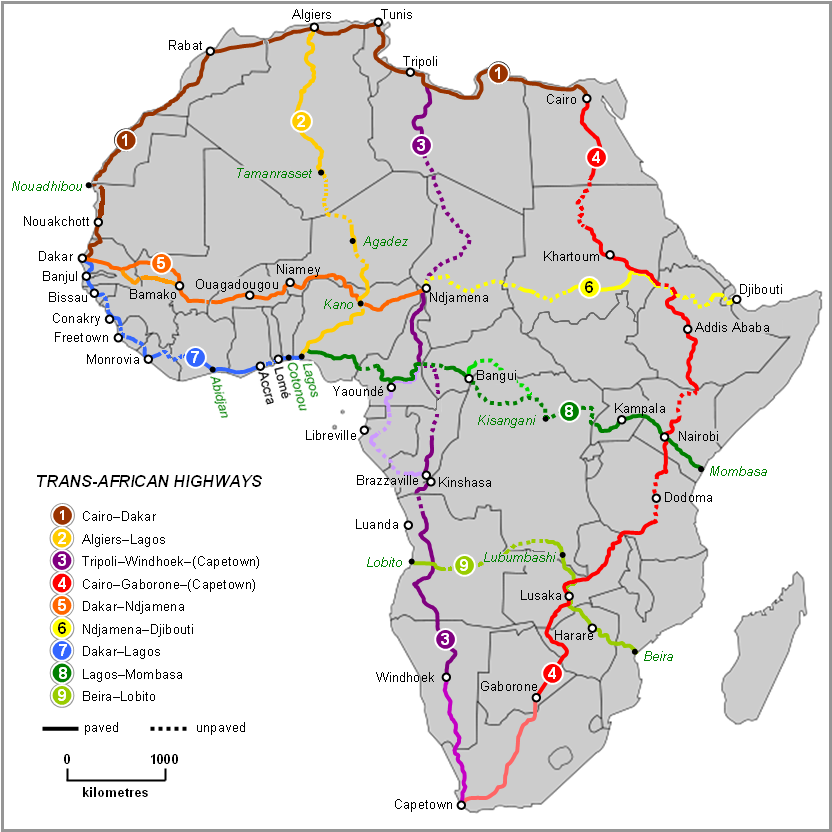
The IBRD and World Bank released a report entitled "Africa's Infrastructure: A Time for Transformation", estimating that the cost of addressing Africa's infrastructure challenge is $93bn per year, one third of which is for maintenance alone.

Other main findings are that infrastructure has been responsible for more than half of Africa's recent improved growth performance, that infrastructure networks are lagging behind other developing countries, that infrastructure services in Africa are twice as expensive as elsewhere, and that infrastructure in Africa is mainly financed by central governments.

For more findings and well-researched discussions read the full report here.

H/T: Polity
Image: WikiMedia

Monday, September 14, 2009

Water Shedding?

It was argued in an earlier post that natural resource constraints, which are generally ignored by macroeconomic planners advising South Africa's government, could have a detrimental impact on South Africa's development path. A new paper by South African economists James Blignaut and Jan van Heerden on water limits to economic development takes a stab in this direction. They do point out that increasing the price of water may help avert such a crises, but remain sceptical on the implementation of such measures:

Is Water Shedding Next?

James Blignaut and Jan van Heerden

July 22, 2009

Abstract

South Africa is in the grip of an electricity crisis marked by a euphemism known as ìload

sheddingî. The demand for electricity has grown to the point that the supply reserve margin is

often under threat, necessitating the electricity supplier to cut supply to some areas for various

periods of time, or to shed load. This is a condition previously unknown to South Africa since

the country has enjoyed electricity security from the mid-1950s. Are we, however, heading in

the same direction when considering water? Is water shedding inevitable?


We ask these questions since South Africa is a country classified has having chronic water

shortages, a condition exacerbated by climate change and the rapidly increasing demand for

water. Can we avert a water shedding crisis by being proactive? In this paper we address

this issue by applying a Computable General Equilibrium (CGE) model using an integrated

database comprising South Africaís Social Accounting Matrix (SAM) and sectoral water use

balances. We refer to AsgiSA, the governmentsíAccelerated and Shared Growth Initiative in

South Africa, and conclude that continuing business as usual will indeed lead to a situation

where water shedding will be inevitable.


Unlike electricity, however, water security is much more serious from livelihood, health and

socio-economic development perspectives since there are no substitutes for it, although its influ-

ence is not directly and immediately visible. This delayed effect can create a degree of comfort

and ill-founded complacency leading to non-action, whereas there is an urgent need for proactive measures.


See here for more on water pricing is an important policy instrument to manage water scarcity and risks.

Thursday, March 5, 2009

Water pricing: insights from Harvard

It has been argued on this blog ("Should water be priced according to its market value?", "On the municipal price of water") that water pricing is an important policy instrument to manage water scarcity and risks.

A recent blogpost (As reservoirs fall, prices should rise) from Prof. Robert Stavins, environmental economist at Harvard University again states this clearly in the US context:

Throughout the United States, water is under-priced.  Efficient use of water will take place only when the price reflects the actual additional cost of making that water available.  Lest one fear that higher water rates would mean that Americans would go thirsty, take note:  On average, each of us uses 183 gallons of water a day for drinking, cooking, washing, flushing, cleaning, and watering, but less than 5% of that is for drinking and cooking combined.  There is plenty of margin for change if people are given the right price signals.

Fifty years of economic analyses have demonstrated that water demand is responsive to price changes, both in the short term, as individuals and firms respond by making do with less, and in the long term, as they adopt more efficient devices in the home and workplace.  For example, when Boulder, Colorado moved from unmetered to metered systems, water use dropped by 40% on a sustained basis.

But prices are typically set well below the social costs of the water supplies, since historical average costs are employed, rather than true additional (marginal) costs of new supplies.  Although water scarcity typically develops gradually across seasons of low rainfall and low accumulations of snow pack, pronounced droughts are usually felt in the summer months of greatest demand.  The economically sensible approach is to charge more at these times, but such “seasonal pricing” is practiced by less than 2% of utilities across the country.

A reasonable objection to jacking up the price of water is that it would hurt the poor.  But we can take a page from the play book of electric utilities who subsidize the first kilowatt-hours of electricity use with very low “life-line rates.”  Indeed, the first increment of water use can be made available free of charge.  What matters is that the right incentives are provided for higher levels of usage.