The African Environmental Economist, a new online daily provides a selection of news that would be of interest to those working in natural resources, energy and environmental sectors in Africa and especially those interested in the role of economics and business in this regard.
For those interested here is the link.
Let me know what you think and please do alert me to any great content that could be posted in future editions.
Showing posts with label Africa. Show all posts
Showing posts with label Africa. Show all posts
Friday, February 3, 2012


Saturday, January 15, 2011
The Roaring Augrabies


When driving upstream it is very clear that the floods that cause this spectacle also have another, more darker side:


It is when a displaced labourer start asking us what to do next after his house was flooded, the extent of the problem starts driving home. Many flood-hit areas have now been declared as national disasters.
Tuesday, March 30, 2010
Lesotho and leadership
Today we climbed Thaba Bosiu, the famous mountain in current Lesotho which used to be the famous King Moshoeshoe I's natural fortress. With lots of grazing and a good source of water it proved to be resistant to Zulus, Ngunis, Boers and Brits. When eventually the Boers did start to seriously threaten the kingdom, Moshoeshoe diplomacy saved the day. Basutoland was placed under British protection, paving the way for a fully independent Lesotho in 1966. Some still refer to Moshoeshoe as Africa's greatest leader.
Thursday, March 25, 2010
Botswana, Ghana, Mauritius and South Africa...
From RePec an article highlighting the importance of governance and institutions in development success:
Development Progress in sub-Saharan Africa: Lessons from Botswana, Ghana, Mauritius and South Africa
| Date: | 2010 |
| By: | Naudé, Wim |
| URL: | http://d.repec.org/n?u=RePEc:unu:wpaper:wp2010-07&r=afr |
| Botswana, Ghana, Mauritius and South Africa are sub-Saharan African countries that stand out for their development progress. Each of these countries has succeeded against the odds, against expectations. This paper synthesizes the common ingredients of these countries’ success, and derives lessons. It concludes that smallness, landlockedness, tropical location, distance from world markets, racism, colonialism and other challenges can be overcome through appropriate institutions, governance and good economic policies. | |
| Keywords: | sub-Saharan Africa, development, success, country role models See also earlier blogposts "Unmasking Africa's seven success stories" and "Go Gabon" |
Monday, February 22, 2010
Food miles or fair miles
I wish to thank Martin for the opportunity to be guest blogger here again, following a few entries from me in the past (mostly Africa and sustainable tourism related). I wish to this time revisit the slightly related topic of food miles and share a recent report of Oxfam and IIED called "Fair miles - recharting the food miles debate" that focuses on African fruit and vegetable exports to the UK.
As the world continues to grapple with climate change, the “buying local” and “food miles” concepts are intuitively appealing, but especially in colder climates (where it is most popular) it is flawed and simplistic based on a false assumption that transport is the only or major cause of greenhouse gas emissions. This ignores the complexity of the food chain from the seed to the plate. Among the more obvious examples is the energy-intensive industrial-scale cultivation in greenhouses having far more environmental impacts than the African low carbon small-scale producer (with a lot of help from the sun).
Some interesting extracts from the report:
"A tomato grown in Essex in the UK is not necessarily more environmentally friendly... if that Essex tomato needed energy-intense greenhouse cultivation to survive. There are, too, other environmental impacts, such as fertiliser use and soil degradation" (p.9)
"Tara Garnett of the Food Climate Research Network (FCRN) — a UK initiative studying greenhouse gas emissions from the food system — led a recent lifecycle analysis of these emissions in the UK. It suggests that transport accounts for about 10 percent of the food system’s emissions." (p.16)
In contrast:
"Agriculture is a top contributor... according to DEFRA, for 36 per cent of greenhouse gas emissions associated with food consumption in the UK" (p.18).
Even "shopping, storage and preparation" (p.27) accounts for more than transport.
"The vast majority of UK farms derive inputs from outside the UK, and consequently are responsible for greenhouse gas emissions that occur outside their locality as well as outside the UK. For many foods, this poses serious questions about their ‘local’ credibility" (p.14)
"To begin to fully understand the social and environmental effects of our food choices, we need to take a look at the entire food supply chain — from farm to manufacturer, to wholesaler or distributor, to retailer, to individual — and the energy use, emissions, and livelihood opportunities associated with each step of that convoluted journey" (p 13)
To really drive home the message that we need to be more holistic than counting the “food miles”, the livelihood dimension is added as final element in the last quote above. The report concludes:
"Kenyans contribute very little to the global emissions burden. And what is more, the entire airfreight trade in fruits and vegetables between the UK and Kenya adds a mere 0.1 per cent to the UK’s total emissions. Given the industrialised world’s historical responsibility for emissions, and its current high per capita emissions, is reducing its carbon footprint from 10.60 to 10.59 tonnes really worth imperilling 1 to 1.5 million livelihoods?" (p.33)
This trade-off is the kind of question that environmental economists need to explore further. Are we in a real inevitable trade-off situation, or is there even a way of minimizing carbon emmisions from African agriculture for export without affecting livelihoods?
Some related articles on this topic from Times online, Prospect magazine and a UK government report from DEFRA and DFID. (Guest blog contribution by Gerhard Buttner: Development and Ecotourism Consultant - South Africa, Mexico and the UK)
Wednesday, February 10, 2010
Transit delays impacts on African exports
| Date: | 2010-01-01 |
| By: | Freund, Caroline Rocha, Nadia |
| URL: | http://d.repec.org/n?u=RePEc:wbk:wbrwps:5184&r=afr |
| This paper examines the effects of transit, documentation, and ports and customs delays on Africa’s exports. The authors find that transit delays have the most economically and statically significant effect on exports. A one-day reduction in inland travel times leads to a 7 percent increase in exports. Put another way, a one-day reduction in inland travel times translates to a 1.5 percentage point decrease in all importing-country tariffs. By contrast, longer delays in the other areas have a far smaller impact on trade. The analysis controls for the possibility that greater trade leads to shorter delays in three ways. First, it examines the effect of trade times on exports of new products. Second, it evaluates the effect of delays in a transit country on the exports of landlocked countries. Third, it examines whether delays affect time-sensitive goods relatively more. The authors show that large transit delays are relat ively more harmful because of high within-country variation. This is a key issue in the food security question (see here for earlier blogpost on the determinants of hunger in SADC). | |
Friday, November 20, 2009
Southern African Regional Climate Change Programme
Africa is expected to bear the brunt of climatic changes (see earlier blogpost The IPCC on Climate Change in Africa). Now there is a new regional Southern African programme to deal with the effects of climate change on the largely poor and malnourished populations in this often forgotten part of the world. With so much anxiety on the success of the Copenhagen talks, this rings at least as a step in the right direction.
From the RCCP website:
"It is in the interests of both the developed and the developing world—North and South—that the impact of climate change on poverty be contained. The Regional Climate Change Programme (RCCP) has been established to help the whole region adapt to climate change. Extending its reach beyond political borders, the RCCP is furthermore committed to helping level the playing field with regard to equitable access to climate funding.
Future life in Southern Africa will depend on the ability of both the environment and the population to adapt to warmer temperatures and greater unpredictability in weather patterns. This variability is already having a negative impact on progress toward the Millennium Development Goals of water, agriculture, health and energy."
Future life in Southern Africa will depend on the ability of both the environment and the population to adapt to warmer temperatures and greater unpredictability in weather patterns. This variability is already having a negative impact on progress toward the Millennium Development Goals of water, agriculture, health and energy."
Read full story and much more about the programme here.
Friday, November 13, 2009
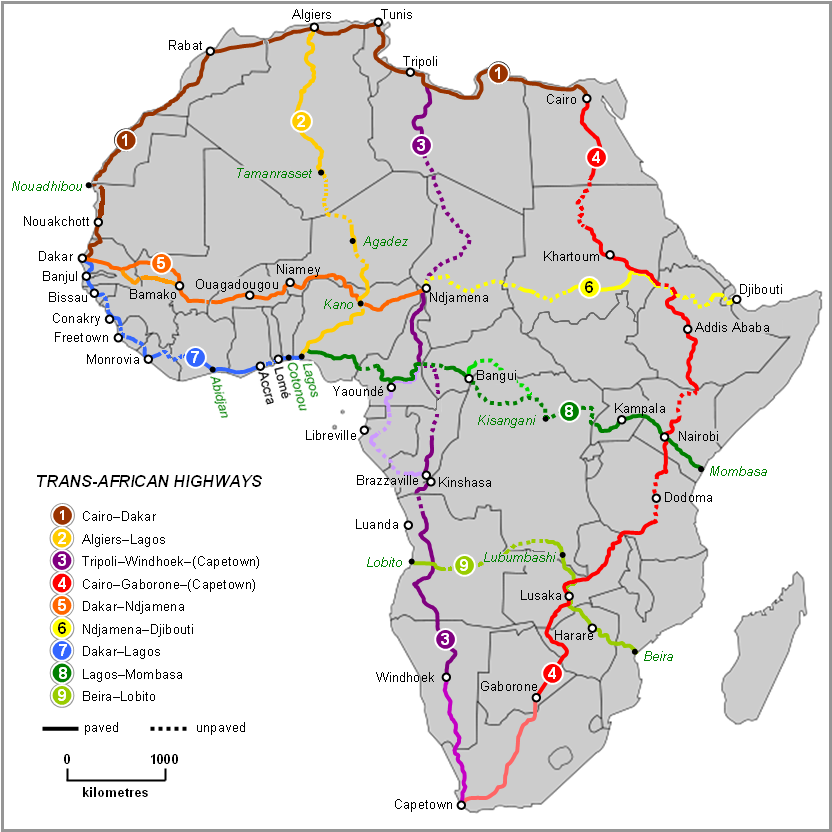
Africa's Infrastructure Challenge

The IBRD and World Bank released a report entitled "Africa's Infrastructure: A Time for Transformation", estimating that the cost of addressing Africa's infrastructure challenge is $93bn per year, one third of which is for maintenance alone.
Other main findings are that infrastructure has been responsible for more than half of Africa's recent improved growth performance, that infrastructure networks are lagging behind other developing countries, that infrastructure services in Africa are twice as expensive as elsewhere, and that infrastructure in Africa is mainly financed by central governments.
For more findings and well-researched discussions read the full report here.
H/T: Polity
Image: WikiMedia
Thursday, October 15, 2009
Hunger in sub-Saharan Africa
The 2009 Global Hunger Index reveals the disturbing reality that hunger is on the rise again in the region. Although GHI declined overall in sub Saharan Africa, nearly all the countries in which the GHI rose since 1990 are in the region. Both in the DRC and in Burundi the GHI has reached alarmingly high levels.
The report states as reasons for this growing food insecurity: government ineffectiveness, conflict, political instability and high rates of HIV and AIDS, noting that the financial crises adds to the vulnerability of the hungry. The report further argues that reducing gender inequality is an important part of the solution to global hunger.
Tuesday, September 8, 2009
Adaptation!?
Adapting to the impacts of climate change needs much more attention, especially for a developing continent such as Africa, an idea that was supported in earlier posts on this blog (See: In Africa climate change = adaptation, Africa and Adaptation, Let's not forget adaptation)
This time another article From Project Syndicate:
COPENHAGEN – Striking the right balance between preventing global warming and adapting to its effects is one of the most important – and most vexing – policy questions of our age. It is also often ignored.
According to the conventional wisdom of many environmental campaigners, we should first do everything we can to mitigate global warming, and only then focus on adaptation strategies. This seems wrong – even immoral – if we could do more for people and the planet through adaptation.
Read here for full article.
Read here for the background economic analysis supporting the article.
Tuesday, August 25, 2009
Fragile Growth
Every now and then we post something on the topic of African growth. This time starting with a a new study published in the Journal of African Economies.
How Fragile Is Africa's Recent Growth?
Office of the Chief Economist, Africa Region, The World Bank, The Brookings Institution, Washington, D.C. 20433, USA
* Corresponding author: Jorge Saba Arbache. E-mail: jarbache@worldbank.org.
Has Africa finally reached the path to sustained growth? We find that much of the improvement in economic performance in Africa after 1995 is attributable to a substantial reduction in the frequency and severity of growth declines in all economies and an increase in growth accelerations in mineral-rich economies. We find, however, that growth accelerations have not been generally accompanied by improvements in variables often correlated withlong run growth, such as investment. We also fail to find evidence that substantial policy and governance improvements were associated with the post-1995 accelerations. We conclude that Africa's growth recovery remains fragile.
In an earlier post it was argued that sub-Saharan growth is largely achieved by a depletion of capital. It does not seem that the badly needed investments to maintain or expand the regions' productive base is realising. It was also pointed out earlier that economic growth does not lead to meaningful gains in social development.
The conclusion becomes stronger that the gains of growth in sub-Saharan Africa is dissipating. One of the reasons could be the high volatility of growth in Africa.
The obvious response is to question growth in itself, but to lift millions of people out of poverty growth is needed. Not less growth, but more (inclusive, transparent and environmentally friendly) growth is what Africa needs.
Monday, August 17, 2009
Low income countries benefit from open access
From Online Access to Research in the Environment (OARE) website:
Online Access to Research in the Environment
Online Access to Research in the Environment (OARE), an international public-private consortium coordinated by the United Nations Environment Programme (UNEP), Yale University, and leading science and technology publishers, enables developing countries to gain access to one of the world's largest collections of environmental science research.
Over 2,990 peer reviewed titles (as of 4/2009) owned and published by over 340 prestigious publishing houses and scholarly societies are now available in more than 100 low income countries. Research is provided in a wide range of disciplines, including Biology; Biotechnology, Genetics & Genetically Modified Species; Botany & Plant Biodiversity; Climatology, Climate Change & Meteorology; Ecology & Wildlife Conservation; Energy Conservation & Renewable Energy; Environmental Chemistry; Environmental & Natural Resource Economics; Environmental Engineering; Environmental Law, Policy & Planning; Fish & Fisheries; Forests & Forestry; Geography, Population Studies & Migration; Geology & Earth Sciences; Natural Environmental Disasters; Oceanography & Marine Biology; Pollution & Environmental Toxicology; Satellite & Remote Sensing Technologies; Soil Sciences and Desertification; Waste Management; Water, Hydrology & Wetlands; and Zoology & Animal Biodiversity.
Friday, July 31, 2009
The Future is Africa?
Afro-optimism at its illustrated best? (I tried wikipedia - they do not even have a page on Afro-optimism...)

Friday, July 10, 2009
Carbon emissions: what is a fair share?
The debate on who should take responsibility for climate change is heating up. Industrialised nations want developing countries to accept reduction targets as well. This brings renewed interest in the question how to compare emissions across nations. The World Resources Institute for example proposed differentiated per capita greenhouse gas emissions targets to counter the obvious inequitable outcomes of absolute emission targets. Moving beyond this proposal is another option published in PNAS to link responsibility of climate change to individuals instead of nations. This means that all of the world's high emitters are treated the same regardless where they live.
This is good news for Africa, which as a result of a large number of carbon poor people, can emit more, and thus, have some space to grow. High carbon intensity and inequality in countries like South Africa is not good news for rich people who will have to accept deeper then average cuts under such a framework.
Thursday, March 26, 2009
A solution for Africa's natural resource curse?
A new report Breaking the Curse by the Open Society Institute of Southern Africa, Third World Network Africa, Tax Justice Network Africa, Action Aid International, and Christian Aid performed a study on mining taxation and transparency in seven African countries, including Ghana, Tanzania, Sierra Leone, Zambia, Malawi, South Africa, and the Democratic Republic of Congo (DRC).
The central argument made by the report is that African governments have not been able to optimize the mining tax revenue due to them before the 2003 to 2008 price boom; neither have they been able to capture the anticipated windfalls during the price boom. This argument is grounded on two main reasons: (i) Mining companies operating in Africa are granted too many tax subsidies and concessions (ii) There is high incidence of tax avoidance by mining companies conditioned by such measures as secret mining contracts, corporate mergers and acquisitions, and various ‘creative’ accounting mechanisms. These two factors coupled with inadequate institutional capacity to ensure tax compliance contribute in a large measure to diminish the tax revenue due to African governments.tax revenue from the mining industry.
The report highlights how to improve the situation from a state-revenue side. This is only one part of the story though. More money into state coffers can help address development objectives, but certainly does not guarantee it. Maybe a follow-up report on how government efficiency and transparency is needed to responsibly invest these revenues in meeting development objectives? (see also AfriMap for existing initiatives in this regard).
Tuesday, December 16, 2008
The smell of Africa
It is not a romantic smell. It is not the smell of free people, living as they would choose. Rather, it is the smell of people who labour, strain, and toil for every drop of sustenance their body receives from the earth. It is the smell of of people who have been marginalised and disempowered and forgotten. It is the smell of of people without a voice in a world where only the loud are fed. It is the smell of people who are alive only because they are cunning, ingenious, and endlessly resourceful. In theory they are "peasants". In practice they are brilliantly versed in the skill of surviving.
A passage from Scribbling the Cat. Travels with an African Soldier by Alexandra Fuller.
Absolutely brilliant.
Monday, December 1, 2008
Poverty and violence
From VoxEU.org - a new study on poverty and violence in Africa:
This column suggests that in Africa an income drop of 5%—a large but altogether common deterioration in economic conditions—increases the risk of civil conflict in the following year to nearly 30%. This suggests that aid agencies could help prevent war by targeting short-term emergency aid towards countries hard-hit by adverse commodity price movements or weather shocks.
...
If we believe that a direct link connects poverty and violence, then when failing rains create economic hardship, war should follow. In this case, we can actually figure out whether poverty caused violence by isolating rainfall’s effects. Drought and the resulting economic hardship turn out to matter a lot for understanding conflict in Africa. In work with co-authors Shanker Satyanath and Ernest Sergenti of NYU, we find that a 1% decline in national GDP increases the likelihood of civil conflict by about 2 percentage points. So an income drop of 5%—a large but altogether common deterioration in economic conditions, especially when the rains fail—increases the risk of civil conflict in the following year to nearly 30%, up from an already-high average probability of conflict in Africa of around 20% in normal rainfall years. So we find that short-term shocks to income – exactly the type that Djankov and Reynal-Querol purport to study – do trigger violent conflict on the world’s war-prone continent.
This is an interesting observation. It also begs the next question how aid organisations, governments and society as a whole can effectively react to such shocks. Apart from preventing those few that can be controlled, it is more a matter of keeping "the fingers on the pulse" and to have sensitive systems in place that can "hear the baby cry". That means a lot of flexibility and adaptability.
Monday, November 24, 2008
Steady increase in greenhouse gases
Despite Kyoto and much talk about climate change, greenhouse gases of 40 industrialised nations are on the increase (again).
From the UN News Centre:
Greenhouse gas emissions of 40 industrialized countries rose by 2.3 per cent between 2000 and 2006, while still about 5 per cent below the 1990 level, according to United Nations figures released today, two weeks before a major review conference on the issue.
For the smaller group of industrialized countries that ratified the 1997 Kyoto Protocol setting reduction targets, emissions in 2006 were about 17 per cent below the Protocol’s 1990 base line, but they still grew after 2000. The pre-2000 decrease stemmed from the economic decline of transition countries in Eastern and Central Europe in the 1990s.
Africa is expected to be particularly vulnerable to climatic variability. For Africans this is not good news.
Wednesday, November 19, 2008
Poverty in sub-Saharan Africa: Hydrocarbons to the rescue?
Sub-saharan Africa is going through a hydrocarbon boom. Will this help alleviate poverty? The potential is there, but do not expect miracles without open and transparent governments.
H/T: Common Tragedies
WORLD ENERGY OUTLOOK 2008 FACT SHEET: SUB-SAHARAN AFRICA
Could revenues in oil- and gas-rich sub-Saharan African countries
alleviate energy poverty?
n Oil and gas exports in the top-ten producing sub-Saharan African countries are set
to grow steadily to 2030, providing the means for alleviating poverty and expanding
energy access. In the Reference Scenario, in which no change in government policies is
assumed, their oil exports rise from 5.1 mb/d in aggregate in 2007 to 6.4 mb/d in 2030. Gas
exports, largely as liquefied natural gas (LNG), increase from 21.6 bcm in 2006 to 130 bcm
in 2030. These projections hinge on a reduction in gas flaring, adequate investment and
avoidance of disruption to supplies through civil unrest. The ten countries flared 40 bcm
in 2005 — almost three times the entire region’s gas consumption. These countries could
make direct use of their gas resources by using currently flared gas for power generation
or distributing it in cities. The liquefied petroleum gas (LPG) extracted from natural gas or
produced in refineries can provide a low-cost source of supply for distribution networks.
n Less than a third of households in the majority of oil- and gas-rich countries have access
to electricity or to clean fuels for cooking, like LPG, kerosene, biogas and ethanol
gelfuel. About 150 000 people, mainly women and children, die prematurely each year in
these countries because of indoor air pollution from burning traditional fuels – essentially
fuelwood and charcoal – for cooking in inefficient stoves or open fires. In the absence of new
policy initiatives, the number of people living without electricity and relying on fuelwood
and charcoal for cooking rises over the Outlook period, as the population grows.
n Government revenues from oil and gas are set to rise strongly, giving these countries
the means to speed up economic and social development and alleviate poverty. The
government take in the top ten oil- and gas-producing countries is projected to rise from
some $80 billion in 2006 to about $250 billion in 2030. Nigeria and Angola account for 86%
of the $4.1 trillion cumulative revenues of all ten countries over 2006-2030. All these
countries desperately need sustained and sustainable economic development. Modern
energy services are a crucial prerequisite, bringing major benefits to public health, social
welfare and economic productivity. In most of the countries, improving energy access
will entail fundamental political, institutional and legislative reform, as well as efforts
to strengthen the capability of regional and local authorities to implement programmes
and to expand access to credit.
n The upfront cost of expanding access to modern energy is small relative to the wealth
that these countries’ hydrocarbon resources will generate. An estimated $18 billion is
needed to achieve universal access to electricity and to LPG cooking stoves and cylinders
– a mere 0.4% of the projected cumulative government revenues from oil and gas export
revenues in 2007-2030. The cost relative to the government take in Equatorial Guinea,
Angola and Gabon is only 0.1%.
n Sub-Saharan Africa’s hydrocarbon-resource wealth will lead to economic development
only if governments manage wisely and honestly the development of the sector
and the revenues that accrue. An improvement in the efficiency and transparency of
revenue allocation and the accountability of governments in the use of public funds
would improve the likelihood that oil and gas revenues are actually used to alleviate
poverty generally and energy poverty specifically.
Monday, October 27, 2008
Air travel to Africa and climate change
The issue of carbon emissions caused by air travel is becoming an increasingly heated debate. Soon regulating airline emissions could become an integral part of the UK climate change bill.
This raises the question of what would happen in poorer countries of Africa (and elsewhere) which rely on tourism for much-needed international revenue and regard tourism as important part of their development strategy, if tourists would stop coming due to changes in air travel regulations. One helpful suggestion for tourists is given on the topic by an Africa specialist travel agency Rainbow Tours, which forms part of the Ethical Tour Operators Group in the UK:
"It is estimated that one new job is created by every eight tourists, and one job supports up to twenty people. In modern times, flying is an essential part of any trip to Africa, and if people were to stop visiting Africa because of a desire to cut down on flying, the effect on communities would be catastrophic. In many areas, tourism offers the only chance of employment and hope for the future.
Maybe a solution is to travel less and for longer. Make one longer visit, instead of two. We don’t offer long-weekends in Zanzibar, or in Cape Town. Cut out the flights you can afford to go without – to Edinburgh or Paris – and travel by train. Cut out the short-break in Barcelona, turn down the central heating and wear a jumper, but please don’t stop visiting Africa. They need you there."
However, it is clear that this issue also needs to be tackled at an international level far beyond the individual traveler´s decision-making , taking into account the relative importance of tourism for development in a tourist host region and even the much lower average carbon emission levels of the poorer host country rather than only the levels of the country of origin of the tourists.
H/T: Ron Mader - planeta.com, Green Travel Network
This raises the question of what would happen in poorer countries of Africa (and elsewhere) which rely on tourism for much-needed international revenue and regard tourism as important part of their development strategy, if tourists would stop coming due to changes in air travel regulations. One helpful suggestion for tourists is given on the topic by an Africa specialist travel agency Rainbow Tours, which forms part of the Ethical Tour Operators Group in the UK:
"It is estimated that one new job is created by every eight tourists, and one job supports up to twenty people. In modern times, flying is an essential part of any trip to Africa, and if people were to stop visiting Africa because of a desire to cut down on flying, the effect on communities would be catastrophic. In many areas, tourism offers the only chance of employment and hope for the future.
Maybe a solution is to travel less and for longer. Make one longer visit, instead of two. We don’t offer long-weekends in Zanzibar, or in Cape Town. Cut out the flights you can afford to go without – to Edinburgh or Paris – and travel by train. Cut out the short-break in Barcelona, turn down the central heating and wear a jumper, but please don’t stop visiting Africa. They need you there."
However, it is clear that this issue also needs to be tackled at an international level far beyond the individual traveler´s decision-making , taking into account the relative importance of tourism for development in a tourist host region and even the much lower average carbon emission levels of the poorer host country rather than only the levels of the country of origin of the tourists.
H/T: Ron Mader - planeta.com, Green Travel Network
Subscribe to:
Posts (Atom)