Tuesday, March 30, 2010
Lesotho and leadership
Today we climbed Thaba Bosiu, the famous mountain in current Lesotho which used to be the famous King Moshoeshoe I's natural fortress. With lots of grazing and a good source of water it proved to be resistant to Zulus, Ngunis, Boers and Brits. When eventually the Boers did start to seriously threaten the kingdom, Moshoeshoe diplomacy saved the day. Basutoland was placed under British protection, paving the way for a fully independent Lesotho in 1966. Some still refer to Moshoeshoe as Africa's greatest leader.


Thursday, March 25, 2010
Botswana, Ghana, Mauritius and South Africa...
From RePec an article highlighting the importance of governance and institutions in development success:
Development Progress in sub-Saharan Africa: Lessons from Botswana, Ghana, Mauritius and South Africa
| Date: | 2010 |
| By: | Naudé, Wim |
| URL: | http://d.repec.org/n?u=RePEc:unu:wpaper:wp2010-07&r=afr |
| Botswana, Ghana, Mauritius and South Africa are sub-Saharan African countries that stand out for their development progress. Each of these countries has succeeded against the odds, against expectations. This paper synthesizes the common ingredients of these countries’ success, and derives lessons. It concludes that smallness, landlockedness, tropical location, distance from world markets, racism, colonialism and other challenges can be overcome through appropriate institutions, governance and good economic policies. | |
| Keywords: | sub-Saharan Africa, development, success, country role models See also earlier blogposts "Unmasking Africa's seven success stories" and "Go Gabon" |
Wednesday, March 17, 2010
Quote of the day: The future of capitalism
"Coming back to the question whether capitalism is failing, the discussions and findings in the papers in this issue suggest that capitalism is here to survive but the role played by governments is likely to increase over time."
From:
Future of capitalism: Is it failing?
By
Ali M. Kutan
In
Economic Systems, Volume 34, Issue 1, March 2010, Pages 1-2
Wednesday, March 3, 2010
A new era of complexity in economics
A new working paper on the era of complexity in economics:
| Date: | 2010-01 |
| By: | David Colander Richard P.F. Holt J. Barkley Rosser |
| URL: | http://d.repec.org/n?u=RePEc:mdl:mdlpap:1001&r=evo |
| This article argues that the neoclassical era in economics has ended and is being replaced by a new era. What best characterizes the new era is its acceptance that the economy is complex, and thus that it might be called the complexity era. The complexity era has not arrived through a revolution. Instead, it has evolved out of the many strains of neoclassical work, along with work done by less orthodox mainstream and heterodox economists. It is only in its beginning stages. The article discusses the work that is forming the foundation of the complexity era, and how that work will likely change the way in which we understand economic phenomena and the economics profession. | |
Click here for full PDF.
For earlier blogposts on the topic of complexity in cities see here.
H/T: nep.repec
Wednesday, February 24, 2010
Energy transitions: insights from almost 30 years ago
It could have been written today:
ECONOMIC VULNERABILITY AND THE ENERGY TRANSITION
John D. Sterman
The economy is likely to face a prolonged period of economic
vulnerability due to the continued depletion of nonrenewable resources, slow
development of alternative sources, and lags in the adjustment of energy
consumption to higher prices. The magnitude and duration of the vulnerability
is strongly influenced, however, by the technological and institutional
charactersitics (sic) of alternative energy sources...
...Neither energy planning nor economic policy can be conducted
in isolation from the other, or without consideration of the disequilibrium
dynamics of the transition.
Click here for full PDF.
Monday, February 22, 2010
Food miles or fair miles
I wish to thank Martin for the opportunity to be guest blogger here again, following a few entries from me in the past (mostly Africa and sustainable tourism related). I wish to this time revisit the slightly related topic of food miles and share a recent report of Oxfam and IIED called "Fair miles - recharting the food miles debate" that focuses on African fruit and vegetable exports to the UK.
As the world continues to grapple with climate change, the “buying local” and “food miles” concepts are intuitively appealing, but especially in colder climates (where it is most popular) it is flawed and simplistic based on a false assumption that transport is the only or major cause of greenhouse gas emissions. This ignores the complexity of the food chain from the seed to the plate. Among the more obvious examples is the energy-intensive industrial-scale cultivation in greenhouses having far more environmental impacts than the African low carbon small-scale producer (with a lot of help from the sun).
Some interesting extracts from the report:
"A tomato grown in Essex in the UK is not necessarily more environmentally friendly... if that Essex tomato needed energy-intense greenhouse cultivation to survive. There are, too, other environmental impacts, such as fertiliser use and soil degradation" (p.9)
"Tara Garnett of the Food Climate Research Network (FCRN) — a UK initiative studying greenhouse gas emissions from the food system — led a recent lifecycle analysis of these emissions in the UK. It suggests that transport accounts for about 10 percent of the food system’s emissions." (p.16)
In contrast:
"Agriculture is a top contributor... according to DEFRA, for 36 per cent of greenhouse gas emissions associated with food consumption in the UK" (p.18).
Even "shopping, storage and preparation" (p.27) accounts for more than transport.
"The vast majority of UK farms derive inputs from outside the UK, and consequently are responsible for greenhouse gas emissions that occur outside their locality as well as outside the UK. For many foods, this poses serious questions about their ‘local’ credibility" (p.14)
"To begin to fully understand the social and environmental effects of our food choices, we need to take a look at the entire food supply chain — from farm to manufacturer, to wholesaler or distributor, to retailer, to individual — and the energy use, emissions, and livelihood opportunities associated with each step of that convoluted journey" (p 13)
To really drive home the message that we need to be more holistic than counting the “food miles”, the livelihood dimension is added as final element in the last quote above. The report concludes:
"Kenyans contribute very little to the global emissions burden. And what is more, the entire airfreight trade in fruits and vegetables between the UK and Kenya adds a mere 0.1 per cent to the UK’s total emissions. Given the industrialised world’s historical responsibility for emissions, and its current high per capita emissions, is reducing its carbon footprint from 10.60 to 10.59 tonnes really worth imperilling 1 to 1.5 million livelihoods?" (p.33)
This trade-off is the kind of question that environmental economists need to explore further. Are we in a real inevitable trade-off situation, or is there even a way of minimizing carbon emmisions from African agriculture for export without affecting livelihoods?
Some related articles on this topic from Times online, Prospect magazine and a UK government report from DEFRA and DFID. (Guest blog contribution by Gerhard Buttner: Development and Ecotourism Consultant - South Africa, Mexico and the UK)
Thursday, February 18, 2010
Three months of Tweeting

africaeconomist spent nearly three active months in the Twitterverse. This is a short account of my experiences and might be informative to those who may think whether it is really worth the effort (like myself 3 months ago).
Statistics. Send out 272 tweets, 4.6 tweets per day, most early morning before 9am.
My top 5 Twitter words are: icio (referral from delicious account), climate, copenhagen, china and oil. Africa does not follow far behind. This does not surprise me at all. The focus of my work is on Africa's development challenge, with a specific interest in the intersection of economy, development and ecology. Trends in 'oil', 'climate' and 'china' will certainly have a profound impact on Africa's development trajectory in future.
Time. It takes time, but not nearly as much as I thought. If one is used to RSS reading and blogging, to Tweet does not come at a lot of additional effort.
Content. I am very surprised in the good content people generally tweet about. Twitter offers far much than the " I feel gloomy today, and you?" kind of conversations. I still rely a lot on RSS feeds though. Most disciplinary journals have also not joined the Tweeting yet.
Twitter has without doubt changed the way information flows and does have an impact on how we learn. It can support collaboration and understanding. It does come with new responsibilities though. Deep thinking, consulting, researching and Twittering at the same time requires discipline. Technological addiction looms everywhere and Twitter addiction is no exception.
How some people can honestly keep up with thousands of tweets still remains a mystery to me. Maybe the objective is not to collaborate or to be better informed. With all those lists and rankings on performance already available online status is probably part of the answer.
The Twitter elite, however, seems to be mainly organisations and people in the business of communication - containing many news agencies and marketeers. For them, it is part of the job, and Twitter provides just another outlet. Hats of to them who have carved out a niche in an area of 75 million accounts and 15 million active Tweeters.
These numbers sound impressive, but are still much less than other social networking sites such as Facebook and LinkedIn. Slack growth in Twitter do raise concern about marginalization though. I'll certainly keep an eye on that.
Image: dewaldp
Wednesday, February 17, 2010
Science and policy: a two-way street
An exchange of words between an imminent economist and a policy maker from an insightful article on the The Oil Drum.
The economist:
Jeffrey Sachs, economic advisor to the UN, in his recently published article, Fixing the Broken Government Policy Process , articulates four manifestations of the breakdown in Washington:
1. Inability to focus beyond the next election
2. Decisions are made through negotiations with those who will be funding the next election (i.e. industry lobbyists)
3. Technical expertise is ignored or bypassed
4. The public is largely excluded from the process
The policy maker:
From Debbie Cook former Mayor and Councilmember of Huntington Beach, CA from 2000-2008 and a US Congressional Candidate; here is my prescription for scientists, professors, and engineers:
1. Participate in the public discourse
2. Publicly challenge your peers who put forward junk science
3. Be mindful of fallacies in your own assumptions
4. Relationships are primary and every policy is derived primarily from relationships, not facts.
To each critic sitting in their ivory tower, I challenge you to create the conditions for these relationships to flourish.
An important way to bridge the science-policy gap is to build relationships and to communicate facts and alternatives in a concise way. Talking about a clash of cultures!
See also earlier blogpost: Policies for a complex and dynamic world
Thursday, February 11, 2010
Mandela's persistent popularity
as measured by Internet traffic.
From Googletrends a picture on relative worldwide traffic on a few Southern African leaders:
Scale is based on the average worldwide traffic of robert mugabe in all years. Learn more
| jacob zuma | 0.50 |
| robert mugabe | 1.00 |
| nelson mandela | 19.5 |
| thabo mbeki | 0.50 |

Wednesday, February 10, 2010
Quote of the day: Entropy and physical limits
In terms of entropy, the two most important physical limits are local over-heating due to limited entropy export capacity and the minimum entropy reduction requirement for concentration of very dispersed materials. The first may be a problem for the local environment around power plants and in cities. For the Earth as a whole, the limit on the rate of entropy export is inessential.
From:
Entropy and economic processes — physics perspectives by Tomas Kåberger and Bengt Månsson, Ecological Economics Volume 36, Issue 1, January 2001, Pages 165-179
Isolated systems may face absolute limits and 'collapse' under the weight of increased entropy. Open systems, like the Earth, with external sunlight and dissipating heat to space, does not.
Transit delays impacts on African exports
| Date: | 2010-01-01 |
| By: | Freund, Caroline Rocha, Nadia |
| URL: | http://d.repec.org/n?u=RePEc:wbk:wbrwps:5184&r=afr |
| This paper examines the effects of transit, documentation, and ports and customs delays on Africa’s exports. The authors find that transit delays have the most economically and statically significant effect on exports. A one-day reduction in inland travel times leads to a 7 percent increase in exports. Put another way, a one-day reduction in inland travel times translates to a 1.5 percentage point decrease in all importing-country tariffs. By contrast, longer delays in the other areas have a far smaller impact on trade. The analysis controls for the possibility that greater trade leads to shorter delays in three ways. First, it examines the effect of trade times on exports of new products. Second, it evaluates the effect of delays in a transit country on the exports of landlocked countries. Third, it examines whether delays affect time-sensitive goods relatively more. The authors show that large transit delays are relat ively more harmful because of high within-country variation. This is a key issue in the food security question (see here for earlier blogpost on the determinants of hunger in SADC). | |
Thursday, January 28, 2010
Easter Island, societal collapse, the ecological crises and the state of economics

I have taken some time of to reflect on the ecological crises. My companion, amongst many others, was Ken Peacock, Living with the Earth. An Introduction to Environmental Philosophy. It contains the stories of collapse in ancient Phoenician society as documented by Vernon Carter and Tome Dale and Eastern Island as written by Jared Diamond.
Although very interesting to read, it struck me that these case studies are illustrating only a very particular view on the ecological crises. This approach emphasises that society and social structures are underpinned, influenced and shaped by independent biophysical factors and forces. The line of argument in both articles is more or less that both the Phoenicians and Eastern Islanders were expanding their population and/or economic power in the face of obvious resource constraints. Their myopic focus brought destruction and ultimate collapse and their stupidity is there for all to see. It is implicated that we are no different and that these examples are chilling case studies of mankind’s current senseless race towards an ecological doomsday. It is a narrative of environmental mortality, and the main culprit, especially for Diamond, lies in overpopulation. Deforestation, soil erosion, unsustainable agricultural practices such as goats on marginal lands are cited as the ecological triggers for collapse which in turn are caused by the intrusion of ever-expanding human populations.
Before reflecting further on these two articles I first want to take a step back into the history of economic thought. The close etymological basis of the words economics ‘oikonomia’ and ecology ‘oikology’ is well-known. What is not so well known, at least outside of the field of economics, is that economics has long since developed in an empirical direction, as based on the approach used in the physical sciences. The idea of ‘nomos’, which was still in inherent in the earlier classical political economy, lost its allure. Economics, at least the dominant neo-classical version of it, become empirical, mathematical, reductionist and libertarian. Its moral philosophy rested in the self-interest of individual agents. Natural resources and the environment were assumed to be in abundant supply, and on the bigger scale of wealth creation, it did not really matter either.
This has not always been the case. In earlier schools of economic thought, especially the Physiocrats, agriculture was seen as the only really productive sector that could generate a surplus. This link to land was still important for later classical economists (Adam Smith, Malthus, Ricardo, Mill and Marx), but it was postulated that surplus is derived from broader production, including factors such as labour and capital. The idea of a natural law, pertinent in the developing physical sciences, was vigorously applied into economic thinking. State regulation was frowned upon as working against the natural forces of enterprise, the results of which is measured as economic growth.
The detachment of wealth creation from agriculture and later land in general, is in my opinion, an important feat in economic thinking. That the physical and material inputs of land and natural resources became effectively ignored in later neo-classical economic thinking is not. What is at least needed at this stage is an acceptance of the laws of thermodynamics, and an acceptance of an “external” ethics, which may culminate through positive (man-made) law. The physical reality is that materials and energy, at least in the forms we know them, are running out. Sunlight provides the ultimate source of energy, and the socio-ecological transition towards using energy “that is closer to the sun” will become an important economic imperative. We are not necessarily talking about absolute limits in the strictest sense here, but of limits in our ability to translate sun-power into energy. It is further not only the supply of energy and materials that matter, but also the rate at which by-products such as waste and pollution can be absorbed by nature. This transition may need to be sped-up in the face of these increased loadings of waste and pollution into the natural environment.
Socio-economic forces may again have a profound impact in how mankind is adapting to the ecological crises. Eastern Island, in fact, may have also experienced a socio-economic transition, one untold in the narrative of human ecology. Recent research published in the American Scientist argued that the island was populated by humans far later than initially thought, that alien rats brought havoc even before the island was really populated, and that it was the contact with Europeans, with their diseases, the ensuing conflict and enslavement which brought the societal collapse.
Tales of ecological destruction and human greed are certainly valid in certain contexts, as are tales of genocide and collapse, I have some difficulties with the current meta-narrative as presented by scholars such as Diamond. I have also serious reservations on the current neo-classical economic thought that ignores the importance of nature, and more, that dismisses the idea of ‘oikonomia’, or the management or stewardship of our dwelling or household. Human ecologists are right in seeing the deficiencies of economic culture, but in their solution portray a kind of biophysical moral philosophy which I find hard to accept.
What this all means and what the implications are for an acceptable socio-ecological theory forward is something that needs much more reflection.
Of to another few days of hard reading...
Monday, January 18, 2010
Economists are stingy
A new study entitled "Why Are Economics Students More Selfish than the Rest?" suggests that economists are less likely to donate than other students. Maybe time to introduce Adam Smith's Theory of Moral Sentiments over and above the much more widely read Wealth of Nations.
The abstract of the study:
| A substantial body of research suggests that economists are less generous than other professionals and that economics students are less generous than other students. We address this question using administrative data on donations to social programs by students at the University of Washington. Our data set allows us to track student donations and economics training over time in order to distinguish selection effects from indoctrination effects. We find that economics majors are less likely to donate than other students and that there is an indoctrination effect for non-majors but not for majors. Women majors and non-majors are less likely to contribute than comparable men. |
Thursday, January 14, 2010
Green fiscal stimulus
A new paper Global Governance: The G20 and a Global Green New Deal analyses the worldwide green fiscal stimulus. South Africa's green stimulus as percentage of the total fiscal stimulus of $7.5bn was 10.7%, compared to the UK's 10.6%, the US's 12%, China's 33.4% and South Korea's 95.2%.
Abstract
As the world recovers from the worst economic crisis since the Great Depression, the international community should promote a mix of policies to sustain this global recovery and create jobs through reducing carbon dependency, ecological degradation and poverty. Such a Global Green New Deal (GGND) requires a long-term commitment to implementing and coordinating “green investments” by the Group of 20 (G20), who should also adopt complementary pricing policies and foster international aid and other actions in support of the GGND. Developing economies should provide clean water and sanitation for the poor, create safety nets, invest in heath and education, and target energy and water poverty. Such a global strategy can revive economies, create jobs and improve the sustainability of world development.Full citation: Edward B. Barbier (2010). Global Governance: The G20 and a Global Green New Deal. Economics: The Open-Access, Open-Assessment E-Journal, Vol. 4, 2010-2. http://www.economics-ejournal.org/economics/journalarticles/2010-2 .
Friday, December 25, 2009
Zimbabwe: Beauty, destruction and surprise

No country has had so much bad press as Zimbabwe in recent years. No country's leadership deserves any less to be frank. In the last few days I had the opportunity to visit this country of destruction and beauty. In the process we had a few very positive and very negative surprises.
"From Zambezi to Limpopo
Our purpose was to visit Chimanimani National Park, a piece of paradise in the eastern highlands of Zimbabwe. It is a rugged and pristine wilderness area catered for the self sufficient hiker. It was 19 years since we have been there and little has changed. The views are stunning, the waterfalls crystal clear and the air so pure that it cures an otherwise chronic sinusitis in a few days.
"Oh lovely Zimbabwe, so wondrously adorned
The serenity of this place stands in stark contrast to the course the country has taken in the last decade or so. The disastrous consequences of Zimbabwe's land reform process is evident everywhere. Production of foreign exchange earning commodities such as sugar cane and tobacco have fallen drastically, while maize production has also more than halved over the period 2000-2007 (see FAO Stats). My own information is that an estimated 200 white farmers are left in Zimbabwe. This compares to 280 white farmers in June 2008 as reported in the Daily Telegraph. Despite these disastrous developments, according to the FAO undernourishment in Zimbabwe remained relatively constant at around 40% of the population. We have witnessed many fields planted with maize and other crops in the rural areas and saw trucks delivering bags of food to remote areas. The question is how sustainable this situation is and whether these rural households are able to withstand any further shocks to their already frail economy.
"May rain abound, and fertile fields;
In Africa one can expect anything. We did experience a few surprises ourselves.
The border post at Beitbridge is a cocktail of diesel, dust and queues. It takes anything between 1.5 and 8 hours for a car to pass the border and it is worse coming back into South Africa. The sheer volume of trucks and people passing into Zimbabwe bodes well to the economy of this beleaguered nation, but do not jump to conclusions before one has seen the queue of Zimbabweans joining the estimated 3 million refugees in South Africa already. The situation may be improving slightly, but it seems as if many Zimbabweans are still choosing a xenophobic South Africa above their own country. For us the place has a new Afrikaans name: "Vasbytbrug", or roughly translated: a bridge where one has to really hang on tightly.
The feared police roadblocks is one of those popular travel myths. We have encountered 20 odd of these roadblocks, but in most cases the Zimbabwean police were friendly and professional. The only two attempts at bribery were easily thwarted by steering the conversation towards more desirable goals, such as the soccer World Cup 2010 or the country's exceptional beauty.
The roads are generally in reasonable condition, that is if one is not too fussy about road markings, road shoulders, cat's eyes and some potholes. It is not a good idea to drive at night though. We have tried it in a dark 100km/h rush towards Beitbridge competing with trucks, taxis, and overloaded bakkies for a slim piece of tar. Not a good idea.
Money remains a challenge though. The country's economy runs on Rands and US dollars, but it gets a bit tough when R/$ conversions come into play. Zimbabwe National Parks, at least in Chimanimani, is still working on a rate of R10 = 1USD (official rate is closer to R7.50/1$). That puts a handsome R2.50 to the dollar into some pocket somewhere!
Safety remains an issue. Despite assurances that Zimbabwe is safer then South Africa, we were the victims of opportunistic theft while hiking in the mountains. According to the authorities, this was the first ever incidence of this nature in the Park. We were quite positively surprised by the response of the authorities. The incidence was treated as a serious transgression and a well-armed search party of National Park rangers, supported by the local police, were on their way in a matter of hours. It is clear that Zimbabwe wants to benefit from the 2010 World Cup and no crimes on visitors will be tolerated.
Image: Wikipedia
Wednesday, December 9, 2009
Hunger and climate change in SADC - summarised
After a few months of data analyses and literature review, a cautious conclusion on hunger in SADC:
In summary, the main threat to undernourishment in SADC is a lack of food consumption. This is mainly influenced by a lack of own production, erratic local prices, a weak spatial integration of food markets, and very low penetration of average income growth to poorer household economies. The additional risks of climate change and competing land use for biofuels increase the vulnerability of the system, most directly on a household level. Direct response options to support farmers and households are important, but not sufficient. Broader reforms in regional and international trade, as well as a focus on socio-economic and political factors, are needed to improve the overall food system in SADC.
Wednesday, November 25, 2009
Water: Tough trade-offs and a call for economic management
The management of water resources is an economic problem. The Water Resources Group 2030, consisting of the International Finance Corportion, McKinsey & Co and an extended business consortium has, in a new report, drawn attention to water scarcity and the need for economic management and further investment in this valuable resource.
A key argument is that current supply will be inadequate, but that meeting increasing demands is possible at a reasonable cost:
After careful quantitative analysis of the problem, this report provides some answers on the
path to water resource security. It first quantifies the situation and shows that in many regions, current supply will be inadequate to meet the water requirements. However, as a central thesis, it also shows that meeting all competing demands for water is in fact possible at reasonable cost. This outcome will not emerge naturally from existing market dynamics, but will require a concerted effort by all stakeholders, the willingness to adopt a total resource view where water is seen as a key, cross-sectoral input for development and growth, a mix of technical approaches, and the courage to undertake and fund water sector reforms.
South Africa was one of the case studies . The report indicates that South Africa will have to resolve tough trade-offs between agriculture, key industrial activities such as mining and power generation, and large and growing urban centers.
Friday, November 20, 2009
A winning conclusion
Partha Dasgupta reviewed the interface between ecological economics and economic development in a new working paper "The Place of Nature in Economic Development". His conclusion wins the Sustainable Options Winning Conclusions Award for this week*:
Development policies that ignore our reliance on ecological capital are seriously harmful - they
don't pass the mildest test for equity among contemporaries, nor among people separated by
time and uncertain contingencies.
* A completely random award to all working on interesting issues spanning from Africa's development challenges to the beauty of sea horses in the Knysna lagoon. In the spirit of the Mo Ibrahim prize it may or may not be awarded.
Southern African Regional Climate Change Programme
Africa is expected to bear the brunt of climatic changes (see earlier blogpost The IPCC on Climate Change in Africa). Now there is a new regional Southern African programme to deal with the effects of climate change on the largely poor and malnourished populations in this often forgotten part of the world. With so much anxiety on the success of the Copenhagen talks, this rings at least as a step in the right direction.
From the RCCP website:
"It is in the interests of both the developed and the developing world—North and South—that the impact of climate change on poverty be contained. The Regional Climate Change Programme (RCCP) has been established to help the whole region adapt to climate change. Extending its reach beyond political borders, the RCCP is furthermore committed to helping level the playing field with regard to equitable access to climate funding.
Future life in Southern Africa will depend on the ability of both the environment and the population to adapt to warmer temperatures and greater unpredictability in weather patterns. This variability is already having a negative impact on progress toward the Millennium Development Goals of water, agriculture, health and energy."
Future life in Southern Africa will depend on the ability of both the environment and the population to adapt to warmer temperatures and greater unpredictability in weather patterns. This variability is already having a negative impact on progress toward the Millennium Development Goals of water, agriculture, health and energy."
Read full story and much more about the programme here.
Friday, November 13, 2009
Africa's Infrastructure Challenge

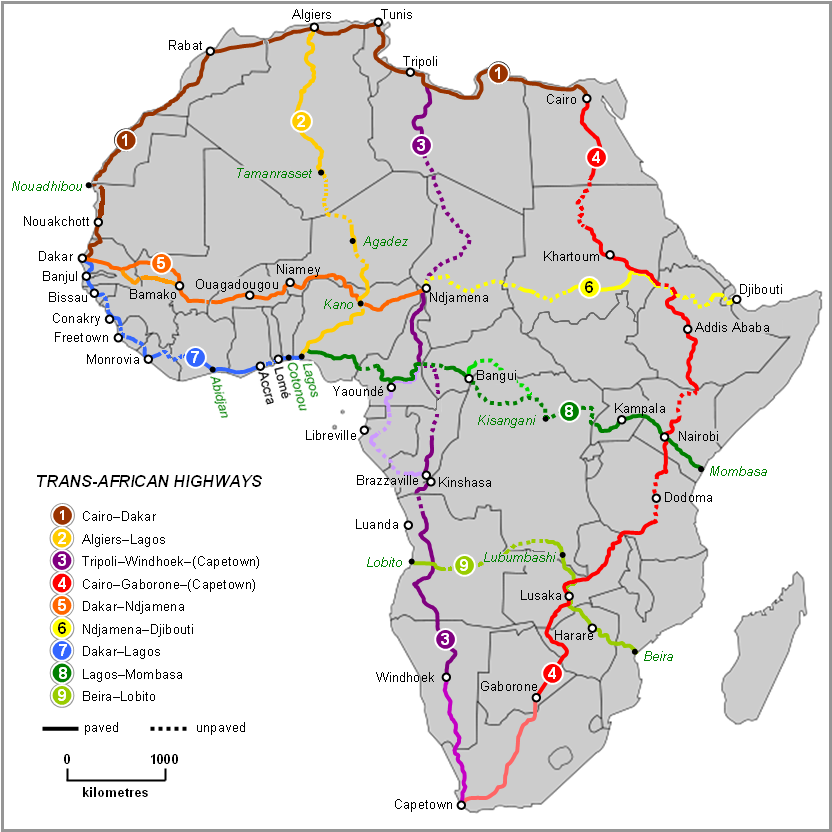
The IBRD and World Bank released a report entitled "Africa's Infrastructure: A Time for Transformation", estimating that the cost of addressing Africa's infrastructure challenge is $93bn per year, one third of which is for maintenance alone.
Other main findings are that infrastructure has been responsible for more than half of Africa's recent improved growth performance, that infrastructure networks are lagging behind other developing countries, that infrastructure services in Africa are twice as expensive as elsewhere, and that infrastructure in Africa is mainly financed by central governments.
For more findings and well-researched discussions read the full report here.
H/T: Polity
Image: WikiMedia
Subscribe to:
Posts (Atom)